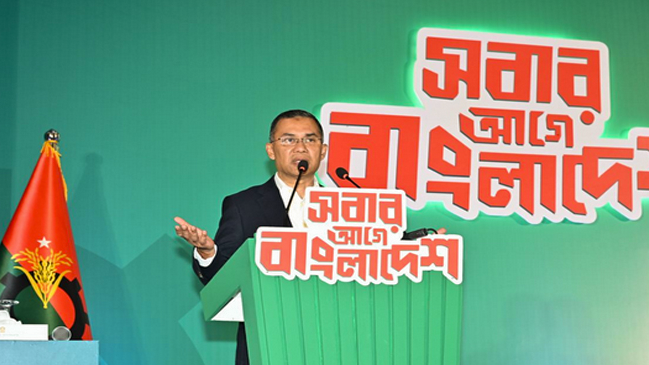
The Bangladesh Nationalist Party (BNP) has unveiled its election manifesto ahead of the 13th National Parliamentary Election, outlining nine major pledges aimed at economic support, social welfare, and institutional reform.
Party Chairman Tarek Rahman announced the manifesto on Friday afternoon at a function held at Sonargaon Hotel in the capital.
Key pledges in the manifesto
Top among the promises is the introduction of a “Family Card” to support marginalized and low-income households. Under the plan, eligible families would receive Tk 2,500 per month or essential goods of equivalent value, with the amount set to increase gradually.
To protect farmers’ interests, BNP pledged to ensure fair prices for agricultural produce through a “Farmer Card.” The initiative would include subsidies, easy loans, crop insurance, and stronger state-managed marketing systems. Fish farmers, livestock rearers, and small agribusiness owners would also be brought under the scheme.
The party promised to build a corruption-free and humane healthcare system by recruiting 100,000 health workers nationwide and expanding quality treatment and preventive services, particularly for mothers and children.
In education, BNP proposed a skill-based and values-driven policy focused on primary education, technology support for teachers and students, and the introduction of a midday meal program.
For young people, the manifesto highlights job creation, technical and language training, support for startups and entrepreneurs, integration into global e-commerce platforms, and merit-based government recruitment.
BNP also plans to expand sports infrastructure and training at district and upazila levels to help turn athletics into a viable profession.
On climate and environment, the party pledged large-scale dredging and re-excavation of 10,000 kilometers of rivers and canals, planting 150 million trees within five years, and introducing modern waste management systems through public participation.
To strengthen religious and social harmony, BNP proposed welfare programs that would provide stipends and training for religious leaders of all faiths.
The manifesto further emphasizes boosting the digital economy by launching international payment platform PayPal, establishing regional e-commerce hubs, and expanding exports of “Made in Bangladesh” products.
BNP described the manifesto as more than an election platform, calling it a “new social and national contract.” The party said it believes in justice and humane politics rather than revenge, placing citizens’ rights at the center of governance.
If elected, BNP pledged to build a Bangladesh where the value of votes is upheld, corruption and inequality are reduced, no one stands above the law, and every citizen can proudly say—Bangladesh comes first.